You've probably been researching this for weeks. Google, YouTube, maybe even Reddit threads from three years ago. You've seen the Costco option, noticed Phantom keeps coming up, and now you're trying to figure out if any of this is actually worth the money—or if you're about to buy something that'll fall apart in two years.
I get it. I've been in the retractable screen door business for over 20 years, and I'll be honest with you upfront: I manufacture screens, so I'm biased. But that bias comes from two decades of seeing what works, what fails, and what homeowners actually care about once the installation crew leaves.
This guide covers everything—how retractable screen doors work, what separates the good ones from the junk, which door types they work best on, and whether you should install one yourself or hire a professional. By the end, you'll know exactly what you're looking at when you get quotes.
A retractable screen door is exactly what it sounds like: a screen that's there when you need it and disappears when you don't. Unlike traditional screen doors that hang in your doorway 24/7—blocking your view, collecting dirt, getting dented by kids and dogs—a retractable screen rolls up into a housing unit mounted on the side of your door frame.
Pull it across when you want airflow and bug protection. Let it retract when you don't. The screen mesh is protected inside the housing when not in use, which is why these things last so much longer than the sliding screen door that came with your house.
You'll also hear them called invisible screen doors, hidden screen doors, or roll-up screen doors. Same concept, different marketing.
The mechanics are straightforward. A spring-loaded roller tube sits inside a vertical housing (the cassette). The screen mesh wraps around this tube. When you pull the screen across the opening, guides or tracks keep the mesh aligned. When you let go, a speed reducer controls how fast it retracts—good ones glide back smoothly, cheap ones slam.
The closure side typically uses magnets or a latch to hold the screen in place against wind. Better brands hide the magnets inside the frame so you don't see them. Budget options have visible magnetic strips that look like an afterthought.
One of the most common questions I get: can you put a retractable screen door on any door? The short answer is yes, with caveats.
Front doors, back doors, side doors—these are the easiest installations. You need a flat mounting surface on the sides and top, and enough clearance for the housing unit. In-swing and out-swing doors both work, though out-swing doors are simpler since the screen doesn't compete with the door for space.
.jpg)
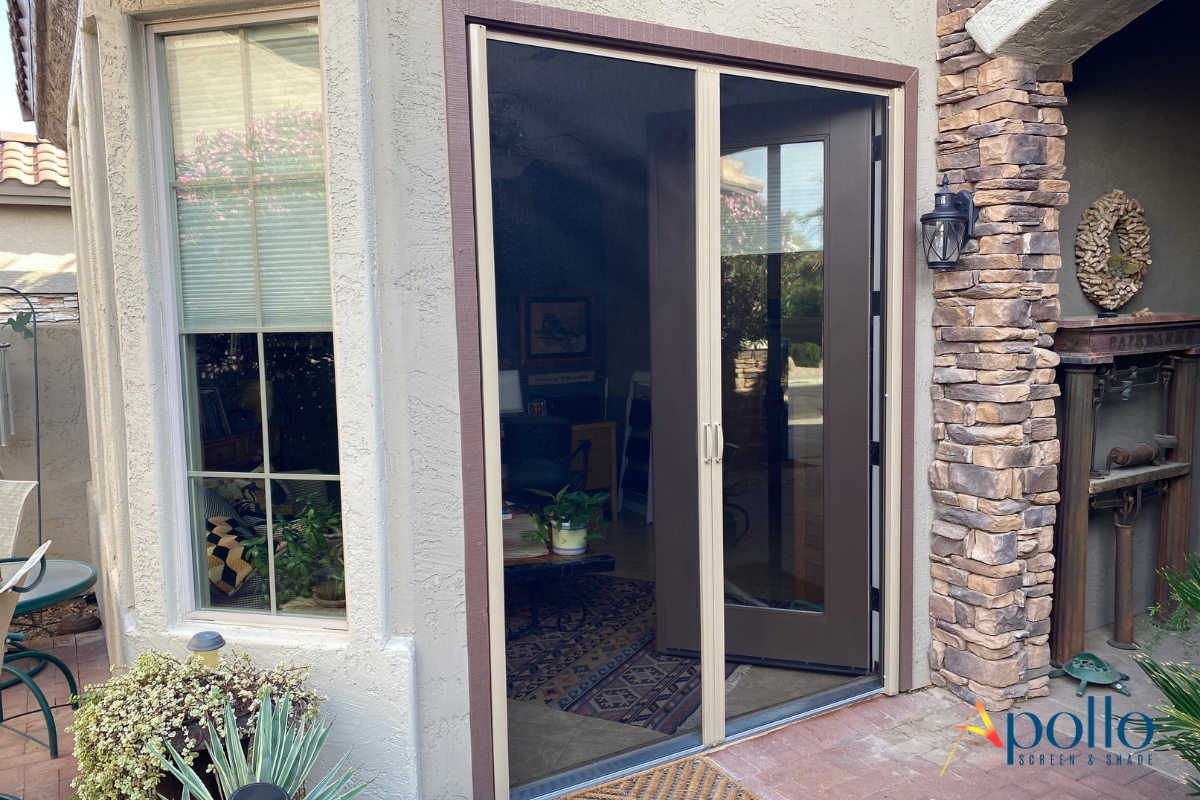
French doors are where retractable screens really shine. Traditional screen doors on French doors look terrible—you've got these beautiful double doors and then two clunky frames blocking the view. A double retractable screen for French doors mounts on each side and meets in the middle. When retracted, you'd never know screens were there.
The installation is more complex because you're aligning two separate screens to seal properly where they meet. This is where DIY gets tricky and professional installation earns its cost.
If you're still fighting with the sliding screen door that came with your house—the one that jumps off the track, sticks, and looks like it's been through a war—a retractable screen door for sliding doors is a serious upgrade. The retractable version operates on a completely different track system that doesn't jam or derail.
Fair warning: you'll need to check your threshold situation. Some vinyl sliders have thresholds that make installation complicated. A good installer will know how to handle it; a DIY kit might leave you with a tripping hazard. See our measuring guide for sliding door screens before you order anything.
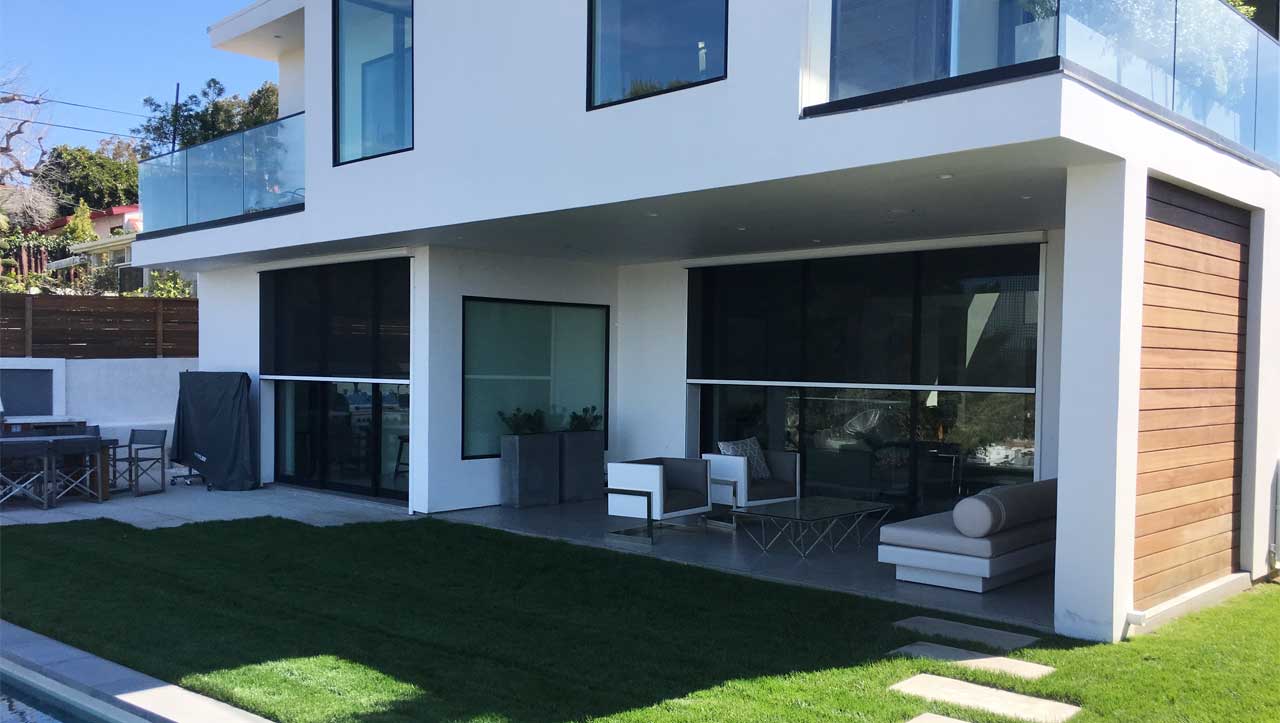
Got a 12-foot opening? La Cantina doors? Multi-panel bifolds? Retractable screens for large openings exist, but this is definitely not DIY territory. You're looking at motorized options in many cases, and the engineering to keep a screen that wide from sagging or binding requires professional fabrication.
I could give you the marketing version, but you can find that anywhere. Here's the honest breakdown from someone who's installed thousands of these things and dealt with every callback you can imagine.
They disappear. That's the whole selling point and they actually deliver on it. When the screen is retracted, most people don't even notice it's there. Your $4,000 front door still looks like a $4,000 front door.
Airflow is better than you'd think. The mesh in a retractable is usually finer than what's stretched across a traditional frame—more air gets through, view is clearer. And because the mesh lives inside a housing when you're not using it, it doesn't bake in the sun or get beat up by weather. I've got screens out there from 2009 that still look new.
They also solve problems other screens can't. Out-swing door? No room for a hinged frame? HOA won't let you install anything visible? Retractables handle all of it.
They won't stop anyone who wants to get in. A retractable screen is bug protection, not security. The mesh cuts with scissors. If you need a security door, that's a completely different product.
They cost more. A hinged screen from Lowe's is $100-200. A quality retractable, installed, starts around $600. You're paying for the mechanism, the look, and the fact that you won't be replacing it every few years.
And not all of them are worth buying. This is the thing nobody tells you upfront: the gap between a good retractable screen and a cheap one is massive. Cheap ones slam shut. They jam. The mesh tears. The housing looks like it belongs on a storage unit. The brand and build quality matter way more than most people realize when they're shopping.
For a deeper breakdown, see our full pros and cons analysis.
Price varies wildly depending on quality, size, and installation method. Here's what you're actually looking at in 2026:

The Costco retractable screen door (the Genius brand) runs around $150-200. It's expandable, meant to fit a range of door sizes, which means plastic adapters and a less-than-perfect fit. For the price, it's fine. You'll get a few years out of it. Don't expect it to look custom or last forever.
Other DIY options from Casper, Brisa, and generic Amazon sellers fall in the $200-400 range. Quality varies. Installation difficulty varies. Results vary.
A professionally installed retractable screen from brands like Phantom, Mirage, ClearView, or Apollo typically runs $600-900 for a standard single door. French doors and larger openings push that to $1,200-1,500 or more.
What does that money get you? Custom measurement, color matching to your trim, proper threshold adaptation, a screen that operates smoothly and doesn't slam, and someone to call if something goes wrong. Professional installers also handle the weird situations—the out-of-square frames, the unusual thresholds, the doors that are taller than standard.
Some manufacturers build the retractable screen into a storm door. Andersen, Larson, and others offer these. Prices run $300-800 depending on features. These make sense if you need a storm door anyway, but they're a different product than a standalone retractable screen.
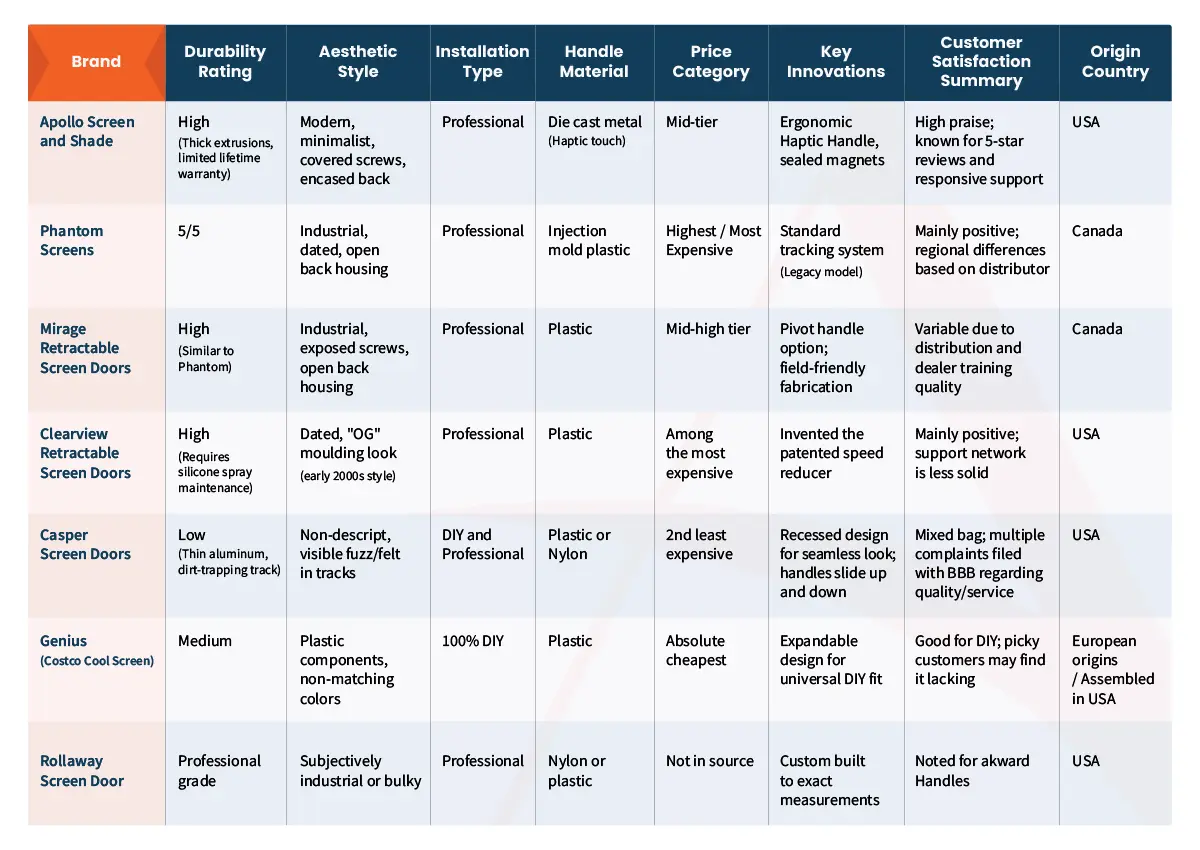
Not all retractable screen doors are the same. Here's what separates the main players. (Full disclosure again: I manufacture Apollo screens, so factor that bias in.)
Phantom is the grandfather of the industry. They've been making retractable screens for 30+ years and basically wrote the playbook everyone else follows. Durability is excellent—these things work and keep working.
The downside? They haven't updated the aesthetics much in those 30 years. The housing has an industrial look. The back of the cassette is open, so you can see the rolled-up mesh from inside your home. And they're typically the most expensive option on the market.
Mirage is Phantom's original competitor and uses a very similar design philosophy. Same durability, same track system that doesn't fail. The screens are popular with mobile screen installers because they're easy to cut to size in the field.
Same aesthetic issues as Phantom—exposed screws, industrial look, no back cover on the housing. Quality of installation depends heavily on your local dealer.
Casper (formerly Reel Screens) uses a different track system than Phantom and Mirage. They offer both DIY and professional installation options for the same product, which is unusual.
Durability is the weak point. I can't tell you how many Casper screens I've ripped out and replaced over the years. Last month alone, two callbacks in the same week—both Caspers, both with the same problem: the bottom track had collected so much grit that the screen wouldn't glide anymore. Thinner aluminum, a dirt-trapping track design, and a mechanism that just doesn't hold up. If you're going DIY, they're easier to install than some others. If longevity matters, look elsewhere.
Solid product, less solid support network. ClearView screens hold up well mechanically, but the look is dated—plastic handles that felt modern in 2005 don't have the same appeal today. Their patented speed reducer was genuinely innovative, but similar technology is now available from other brands.
The most-searched retractable screen door online, thanks to Costco's distribution power. It's 100% DIY, designed to be expandable and fit a range of door sizes.
Pros: Cheapest option, Costco's return policy, no need to schedule an installer.
Cons: Plastic components that don't match the overall design, not custom-fit so gaps are possible, limited color options, durability questions for long-term use.
If you want more detail on how the major manufacturers stack up, see our full comparison of the top 7 brands.
Here's something people don't want to hear: the installer matters more than the brand. I've seen cheap screens installed well that outlast expensive screens installed poorly. A crooked housing, a track that's not level, a bottom rail that doesn't seat right—any of these will make even a great screen feel like junk.
You're handy. You've hung doors before, or at least assembled IKEA furniture without leftover parts. Your door is a standard size with a straightforward threshold—no weird angles, no rotted wood, no surprises waiting for you.
You're also okay with "good enough." DIY kits have limited colors. The fit won't be perfect. And if something goes wrong six months from now, you're the warranty department.
That said—if budget is the main issue and you just want bugs out of your kitchen, the Costco screen for under $200 will do that. I've installed plenty of screens for customers who tried DIY first, gave up, and called me. But I've also met people who nailed it on the first try. Know yourself.
Your door is weird. Taller than 80", wider than 36", or has one of those thresholds that makes you say "what am I even looking at here." You have French doors where both screens need to meet perfectly in the middle. You have a sliding door where the track situation is complicated.
Or—and this is valid—you just don't want to spend your Saturday doing this. Your time has value. A pro shows up, measures, installs, tests it, and leaves. Two hours, done. You didn't have to watch a single YouTube tutorial.
Professional installation also means someone answers when you call. Screen not retracting right? Call the installer. DIY screen not retracting right? You're Googling at 10pm trying to figure out if you can fix it or if you just wasted $300.
Start with your door. Measure the opening—height, width, depth of the frame. Note whether it swings in or out. Look at the threshold and ask yourself if there's a flat surface for a bottom track or if it's going to be a problem. Take photos from a few angles. Any installer worth calling will want to see these before quoting you.
Then be honest about how much you care. Front door that guests see every time they visit? Don't cheap out—a visible housing or wrong color will annoy you for years. Side door to the laundry room? Maybe the Costco option is fine.
And be honest about your DIY skills. This isn't hanging a picture. If you've never used a level or dealt with shims, you're going to have a bad time. I'm not saying don't try it—just know what you're signing up for.
If you're going professional, get at least two quotes and actually check their reviews. Not the brand's reviews—the local installer's reviews. A great screen from a guy who doesn't return calls is worthless.
I'm biased, but yes. And I'd say that even if I didn't manufacture them. The math just works out—you pay more upfront, but you're not replacing the thing every few years and you actually enjoy using it instead of fighting with it.
The one exception: if you're renting, or this is a house you're flipping, or you genuinely don't care what your front door looks like—just grab a $100 hinged screen from Home Depot and call it a day.
The good brands (Phantom, Mirage, Apollo, ClearView) offer lifetime warranties, and they mean it. I've seen 15-year-old Phantom screens still operating fine. The Costco-tier stuff? Figure 3-5 years before something gives out. The spring loses tension, the tracks get janky, the mesh starts to sag.
Yes—and honestly, out-swing doors are easier. The screen mounts inside the frame, the door swings away from it, no conflict. It's in-swing doors where you have to think harder about clearances.
That's the whole point. The mesh stops insects while letting air through. If you're in a no-see-um zone (looking at you, Florida), ask about finer mesh options—standard screen mesh won't catch the tiny ones.
Honestly, not much. Wipe the tracks out once or twice a year, maybe hit the mechanism with silicone spray if it starts dragging. That's it. I've had customers call me after 10 years asking if they should be doing something—nope, you're good, just keep using it.
You now know more about retractable screen doors than most of the people selling them. Seriously. The guy at the home show booth? He started last month.
If you're going DIY, measure three times. Order from somewhere with a decent return policy. And clear your Saturday—it's going to take longer than the box says.
If you want it done right without the headache, get a couple quotes, check the reviews, and hire someone who's been doing this a while. You'll pay more, but you'll also actually use the screen instead of letting it sit there broken because you never got around to fixing it.
Good luck. And stop fighting with that sliding screen—life's too short.

We Believe in Highly Trained and Skilled Local Technicians to Sell, Service & Install Our Products